
Sports Collectibles
$8,000: Genius or Idiot?
October 25, 2026
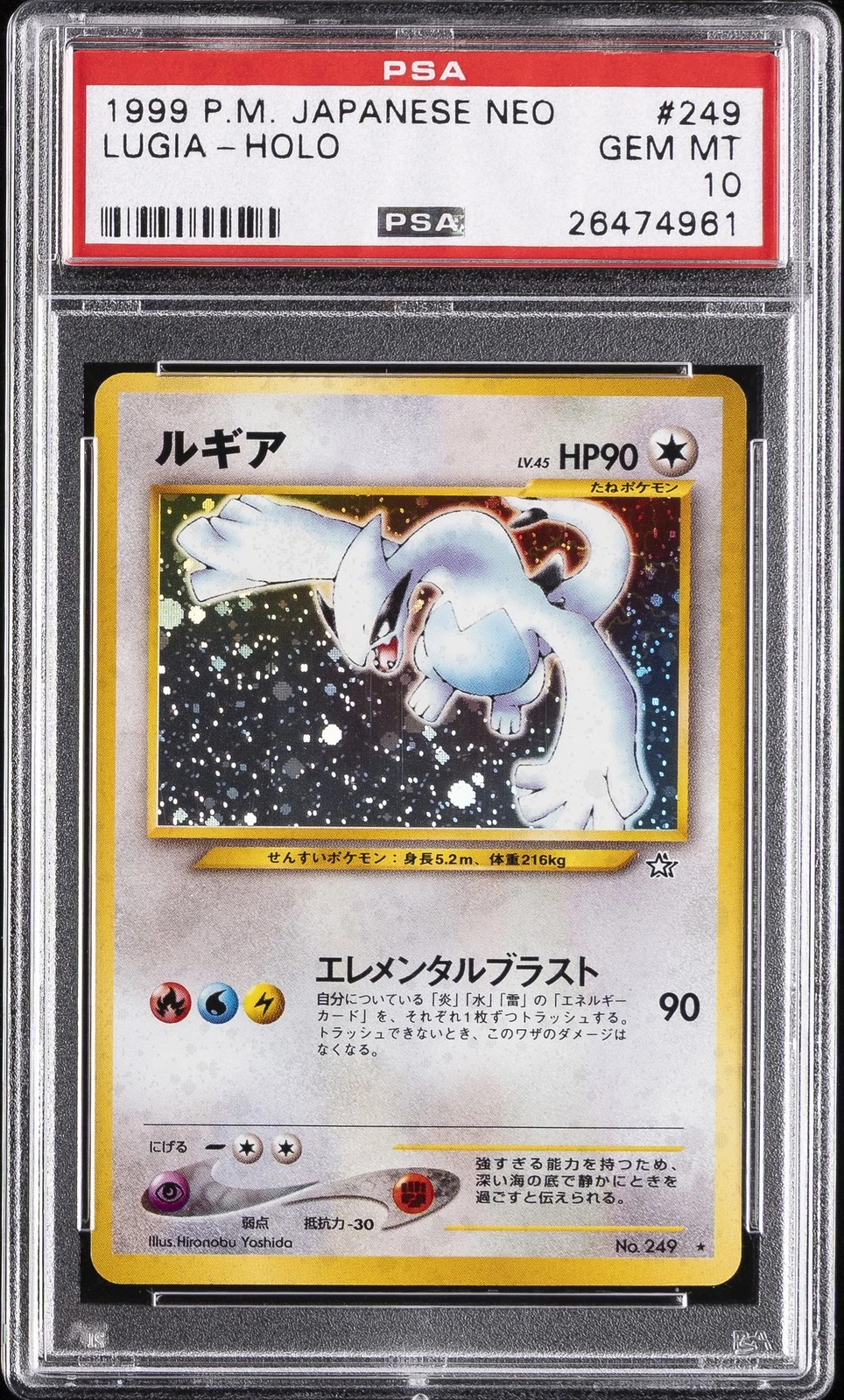
Someone paid $8,000 for a PSA 10 Japanese Neo Lugia, 1.06x the matched-comp median, with no bidding to set the price.
A 2000 Japanese Neo #249 Lugia-Holo, graded PSA 10, sold for $8,000 on October 24. It was a fixed-price listing with zero bids: one buyer, one number, no auction to test it.
Why it matters
This was not the biggest card sale of the day. It was the biggest one we could honestly price. Most of the expensive end of the sports collectibles and TCG market is cards with no comparable sales behind them, and a verdict without comps is an opinion with a dollar sign attached.
By the numbers
- $7,527 — the matched-comp median, from 9 verified sales of the same card at the same grade.
- +$473 — what the buyer paid above that median, or 1.06x.
- $6,699 to $8,850 — the full range of that pool. This sale sits inside it, not above it.
The intrigue
The case for smart money is the price itself. At 1.06x the median the fill scored 30 of 40 on comp deviation, the heaviest component in the model. The pool is tight — its middle half spans $6,958 to $8,000 — so the median is measuring one card, not a bag of lookalikes. The trend reads 5.0% up, so this was not a falling knife. We covered a PSA 8 Neo Genesis Lugia earlier this month; the name keeps surfacing at this end of the board.
Reality check
Two things argue the other way, and one is our own data. Nine sales is a thin foundation, and our own floor is eight — one row either way moves that median, and we would rather say so than bury it. The trend rests on just 4 recent sales. And there were no bids: a fixed-price fill is a negotiated block, not open price discovery, so the market never voted on whether $8,000 was right. That scored 3 of 15.
What's next
The score is 52 of 100: comp deviation 30 of 40, trend 12 of 15, liquidity 3 of 15, price discovery 3 of 15, scarcity 4 of 15. The verdict is FAIR BUY. Nothing was capped — the model simply never reached the GENIUS band. Note where the gap sits: the buyer did well on price and badly on everything describing how easily they get out again. Watch whether the next copy clears at auction instead of buy-it-now.
Between the lines
The biggest sale we tracked that day was a 1996 Japanese #006 Charizard Holo No Rarity in a BGS 8 holder, at $45,256 — and we could not score it, because nothing comparable has sold. Walking down from the top, 56 sales priced above this one could not be scored: 40 returned too few matched sales to quote a median, 2 produced no usable comp query, 2 came back with pools plainly spanning several cards, 5 were rejected for free before we spent anything, and 7 were cards this column has already covered. Our browse hit its row cap, so treat every count here as a floor rather than a total — including the 986 sales we tracked.
Your call
Sold for $8,000. Would you buy at this price?
2000 Japanese Neo #249 Lugia-Holo — PSA 10
Would you buy at this price?
Good deal—
—Overpaid
How we track this
RazMania monitors completed eBay sales daily, filtering out multi-card lots, reprints and cross-listed items to isolate genuine single-card sales. Prices are confirmed sold prices; Best Offer listings are dropped entirely, because eBay publishes the asking price on those and never the settled figure. The comp median here is computed from 9 verified sales of the same card at the same grade. We do not know how many days that comp pool spans, so we do not claim a window. The buy score uses no population report, no sell-through data and no card-level search volume, because we do not have them.
Latest News
Auctions Ending Today: 2022-23 Topps Merlin Chrome UCC Cristiano Sits at $5,000
70 single-card auctions above $5,000 close on eBay today, topped by a...
Magic’s Star Trek prerelease opens with a signed Picard chase and collector boxes far above MSRP
Magic: The Gathering’s Star Trek set opens prerelease Nov. 6. Collector box...
Delta Reign launches with booster boxes near $225 and its Mega Rayquaza chase already sliding
Pokémon’s Delta Reign hits shelves Nov. 6. Booster boxes trade near $225,...
An Aaron Judge jersey keeps its Gold Logoman patch, and that is news for card collectors
MeiGray is selling Aaron Judge’s 469-foot home run jersey with its Gold...